
For site developers and building owners
Turn your site into your own energy company.
Electricity, heat and returns from a single system.
Dezentrale Multi-Energie-Systeme // DMES
Batteries stay outside.
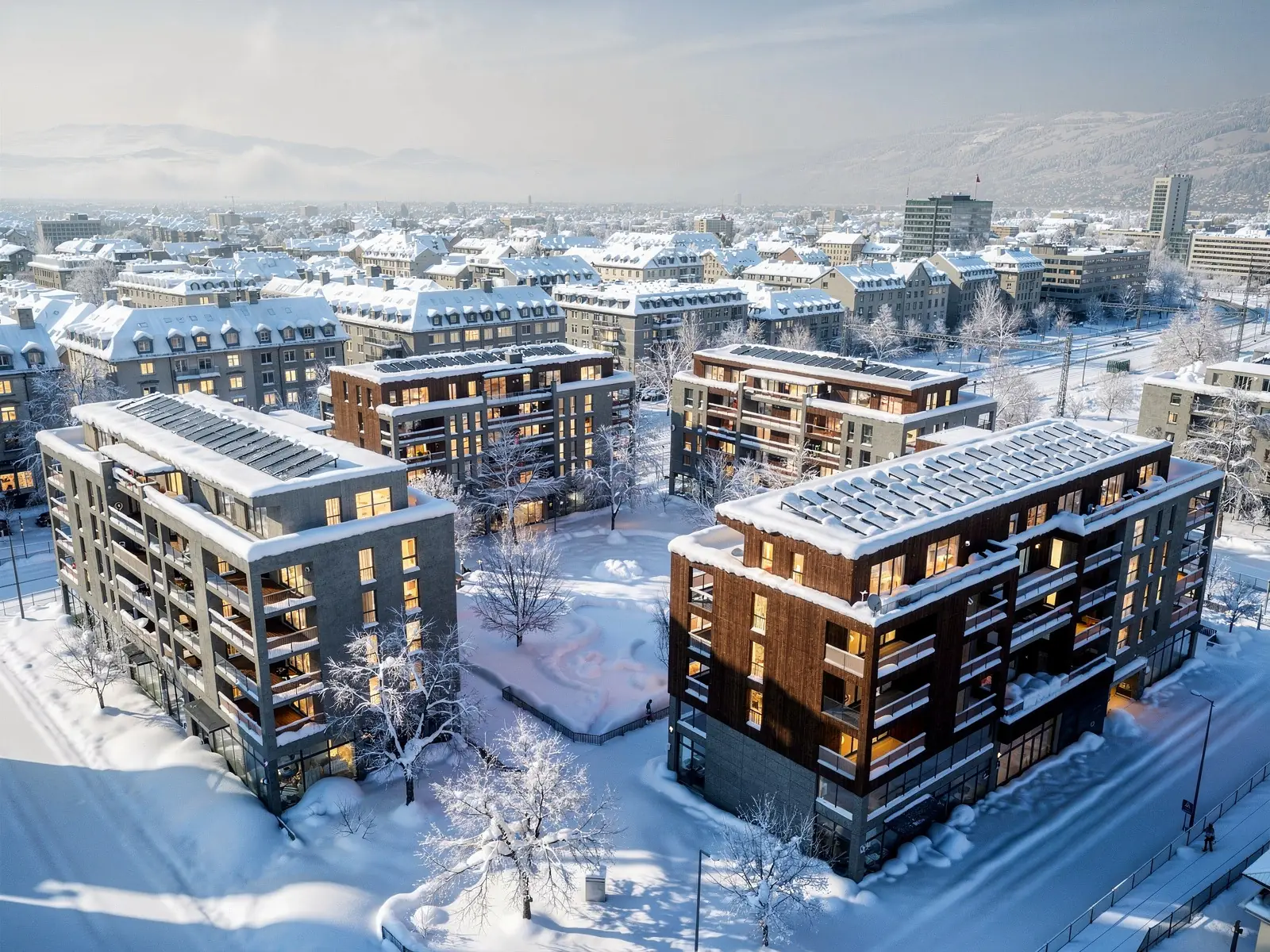
Large-scale storage can be difficult in urban settings. Site developers need long-duration storage for self-consumption, grid relief and new revenue models, but large battery energy storage systems, or BESS, often face major constraints in dense areas. Outdoor containers require cooling in summer and heating in winter, and their noise can trigger objections. Swiss utilities report that around half of their BESS projects fail for this reason. Indoors, lithium-ion batteries create a fire load. Fire compartments, floodable rooms, safety requirements and lost floor space can make large indoor battery stores uneconomic and difficult to approve. The reference work “Areale und Quartiere” (ed. Gugerli, 2024) therefore describes battery storage for day-to-night balancing and identifies hydrogen as the option for seasonal energy storage.
We get inside.
The only large-scale storage system for occupied buildings. Surplus electricity is converted into hydrogen on site and chemically bound in metal hydride, a solid-state storage medium at up to 35 bar. The system is designed to integrate quietly and compactly into the building with 0.5 to 16 MWh per room and modular scalability to over 100 MWh. When required, the stored energy can be returned as electricity and heat, hot water or a heat network. The National Research Programme “Energy” of the Swiss National Science Foundation recommends the implementation of decentralised multi-energy systems, or DMES. eRevo AG Energy Revolution is the pioneer of decentralised multi-energy systems in Europe, developed in Switzerland and proven in real-world operation.
Summer // surplus
-
 Photovoltaics
Own production on the roof
Photovoltaics
Own production on the roof
-
 Electrolysis
Electricity becomes hydrogen and heat
Electrolysis
Electricity becomes hydrogen and heat
-
 H₂ in metal hydride
Solid state at 35 bar, inside the building
H₂ in metal hydride
Solid state at 35 bar, inside the building
Winter // demand
-
 Fuel cell
Hydrogen becomes electricity and heat
Fuel cell
Hydrogen becomes electricity and heat
-
 Electricity
Site, vZEV and LEG, grid
Electricity
Site, vZEV and LEG, grid
-
 Heat
Heating, hot water, heat network
Heat
Heating, hot water, heat network
over 75% overall efficiency with combined electricity and heat use · over 30 years’ service life · 0.5 to 16 MWh per room · modularly scalable to over 100 MWh
How much does your building earn?
Your energy centre should earn money, not cost it. A DMES is not merely a cost item in the construction budget. It can also support revenues for the property. Five levers make the difference.
Flexibility market
Your storage participates in the market. A PV system combined with long-duration storage can make your site a participant in the flexibility market. The resulting revenues flow to you through a single integrated system.
Your own electricity tariff
The spread stays with you. Electricity and heat can be supplied at attractive production costs and passed on to tenants or condominium owners through your own tariff. Within a ZEV, self-consumption rates of 70 to 90 per cent are achievable according to “Areale und Quartiere”, 2024.
Net rent instead of service charges
Higher capitalisation. Lower service charges and higher net rent, with unchanged gross costs for tenants. Higher net rental income raises the capitalised earnings value of your property.
Renewal fund
A selling point for condominium ownership. The DMES can contribute its earnings to the renewal fund, reducing owners’ contributions and strengthening arguments for prospective buyers.
CO2 reduction pathway
Decarbonisation that pays off. Your site advances along its CO2 emissions reduction pathway, measurably and consistently, year after year. From around 1000 tonnes of CO2 per year, additional state funding instruments may become available.
Long-duration storage is becoming the standard. Today, it is your competitive advantage.
Anyone developing projects with an operating horizon of 25 years or more will increasingly need to plan for long-duration storage. The long-duration store works without rare earth elements and without lithium. All materials are available in Europe. Eighty per cent of the production chain is in Switzerland, including fuel cells, metal hydride storage, engineering, production, service, works contracts and placing on the market. The electrolysis comes from Italy. The manufacturer guarantees storage performance for more than 20 years. At decommissioning, the pure metal can return fully to the material cycle.
We remove complexity and improve economic viability.
One system, one point of contact.
System architecture, dimensioning, integration planning and business models all come from eRevo. The system is implemented through a design-build approach with your team and our partner ecosystem. Components, contracting, HVAC, electrical, fire protection and conformity are coordinated within one structure.
Your return, our expertise.
eRevo is a system architect and energy specialist, not a general contractor or a plant operator. We provide the energy system that can improve your return and work within your construction process.
Proven in real-world operation, sought after in planning.
The world premiere installation in Eich has been operating at full load since April 2024. In addition, eRevo is involved in studies and consulting mandates for the SFP site in Root with Integral Design Build, and for site and high-rise projects of the Halter group. Six years of development work have made eRevo AG Energy Revolution the pioneer of decentralised multi-energy systems in Europe.
The next step
Potential analysis
One month, one site, one robust answer. What could a DMES earn at your location, and what size system would be appropriate?