
For HVAC & electrical engineers
Your scope grows. The effort does not.
New technology with familiar interfaces.
Dezentrale Multi-Energie-Systeme // DMES
Your clients are asking about storage.
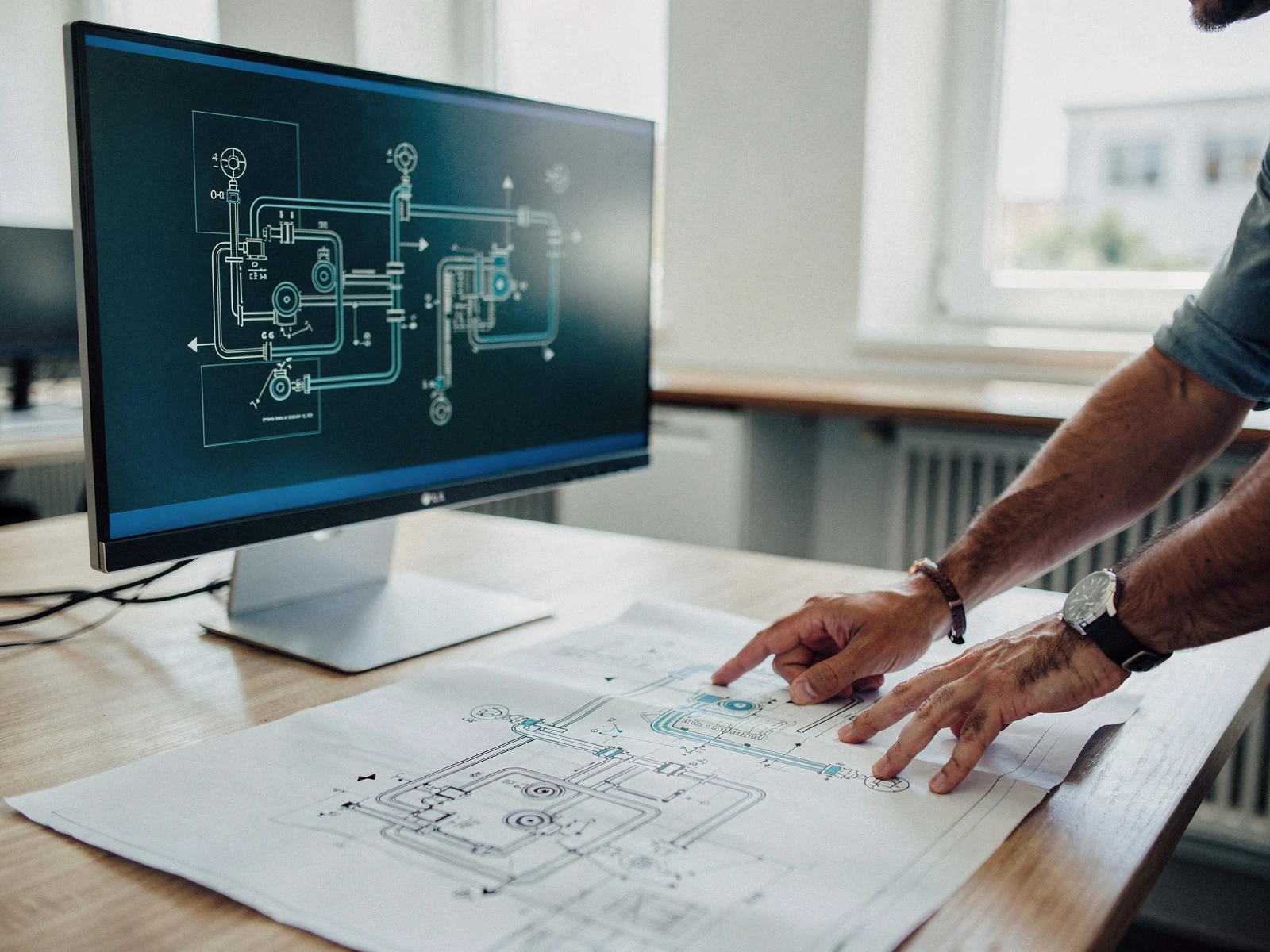
Emissions reduction pathways, self-consumption, and the winter gap. Building owners increasingly demand energy concepts with long-duration storage, and the planning responsibility lands on your desk. The solar obligation and expected negative feed-in prices from 2027 sharpen this further. Anyone who builds PV increasingly needs storage as well. For a practice, new systems can quickly mean extra effort, unclear responsibilities and liability questions. That must not happen. A DMES should therefore be planned like building services, not like a research project, with a guidance note, operating data and defined interfaces.
Where HVAC and electrical plan the same system for the first time.
Everyone remains within their own discipline. A DMES supplies electricity and heat from one energy centre. Thermal integration remains with the HVAC engineer, including heat extraction, hydraulics and the connection to heating, hot water or a heat network. Electrical integration remains with the electrical engineer, including connection, protection concepts and the metering concept for vZEV and LEG. Nobody has to move into another discipline. The system architecture between these disciplines comes from eRevo. At the client's request it can be planned as grid-replacement operation for the building, black-start capable and with autonomy for days thanks to long-duration storage. Whether that is possible and sensible at the site is something we examine case by case. And because the energy is stored in the molecule, the DMES is at the same time the most compact seasonal thermal store, without the large water volumes required by conventional stores. For your practice this means more planning scope within your own discipline and a field of expertise that only a few have occupied so far.
Summer // surplus
-
 Photovoltaics
Own production on the roof
Photovoltaics
Own production on the roof
-
 Electrolysis
Electricity becomes hydrogen and heat
Electrolysis
Electricity becomes hydrogen and heat
-
 H₂ in metal hydride
Solid state at 35 bar, inside the building
H₂ in metal hydride
Solid state at 35 bar, inside the building
Winter // demand
-
 Fuel cell
Hydrogen becomes electricity and heat
Fuel cell
Hydrogen becomes electricity and heat
-
 Electricity
Site, vZEV and LEG, grid
Electricity
Site, vZEV and LEG, grid
-
 Heat
Heating, hot water, heat network
Heat
Heating, hot water, heat network
over 75% overall efficiency with combined electricity and heat use · over 30 years’ service life · 0.5 to 16 MWh per room · modularly scalable to over 100 MWh
The planning bases.
SVGW H10001
Your planning basis. The guidance note for building-integrated H₂ systems addresses safety and approval requirements and was co-developed by eRevo.
Since April 2024
Operating data instead of a brochure. The plant in Eich LU operates at full load and provides robust and verifiable design values.
35 bar
Low pressure. Solid-state storage in metal hydride. No self-discharge and no compression for storage.
0.5 to 16 MWh
Per room. Modularly scalable to over 100 MWh and planned like a plant room.
More than 30 years
Service life. Designed as long-term infrastructure, with storage performance guaranteed by the manufacturer for more than 20 years.
More than 75%
Overall efficiency with coupled use of electricity and heat.
You plan as always, but on a better system.
eRevo supplies system architecture, dimensioning and integration planning with defined interfaces for both disciplines. Specialist planning remains with you, while the DMES expands your scope. The reference work “Areale und Quartiere”, edited by Gugerli in 2024, associates battery storage with day-to-night balancing and hydrogen with seasonal energy storage. That is precisely the system you can plan with us.
Your lead as a practice.
More planning scope within your own discipline.
The energy centre extends HVAC and electrical planning with an additional system. Your fee base grows with it, without requiring you to establish a new specialist field.
Clear interfaces, clear responsibility.
System architecture and component responsibility lie with eRevo and the manufacturers. You plan the integration according to familiar rules, from the preliminary study to commissioning within the SIA phase model.
The field of expertise that only a few have occupied.
Those who plan the first DMES projects today will become the practice that building owners and architects recommend tomorrow. Realised by eRevo AG Energy Revolution, the pioneer of decentralised multi-energy systems in Europe.
The next step
Specialist planner briefing
One hour at your office. We present the system, its interfaces and operating data from Eich to HVAC and electrical, together or separately. Afterwards, you will understand what a DMES means for your planning and where your scope can grow.