Why Triewald
Everything these systems can do, at a glance. Two unique features no other product on the market offers, and twelve reasons why the business case stands up.
large-scale storage system allowed inside an occupied building.
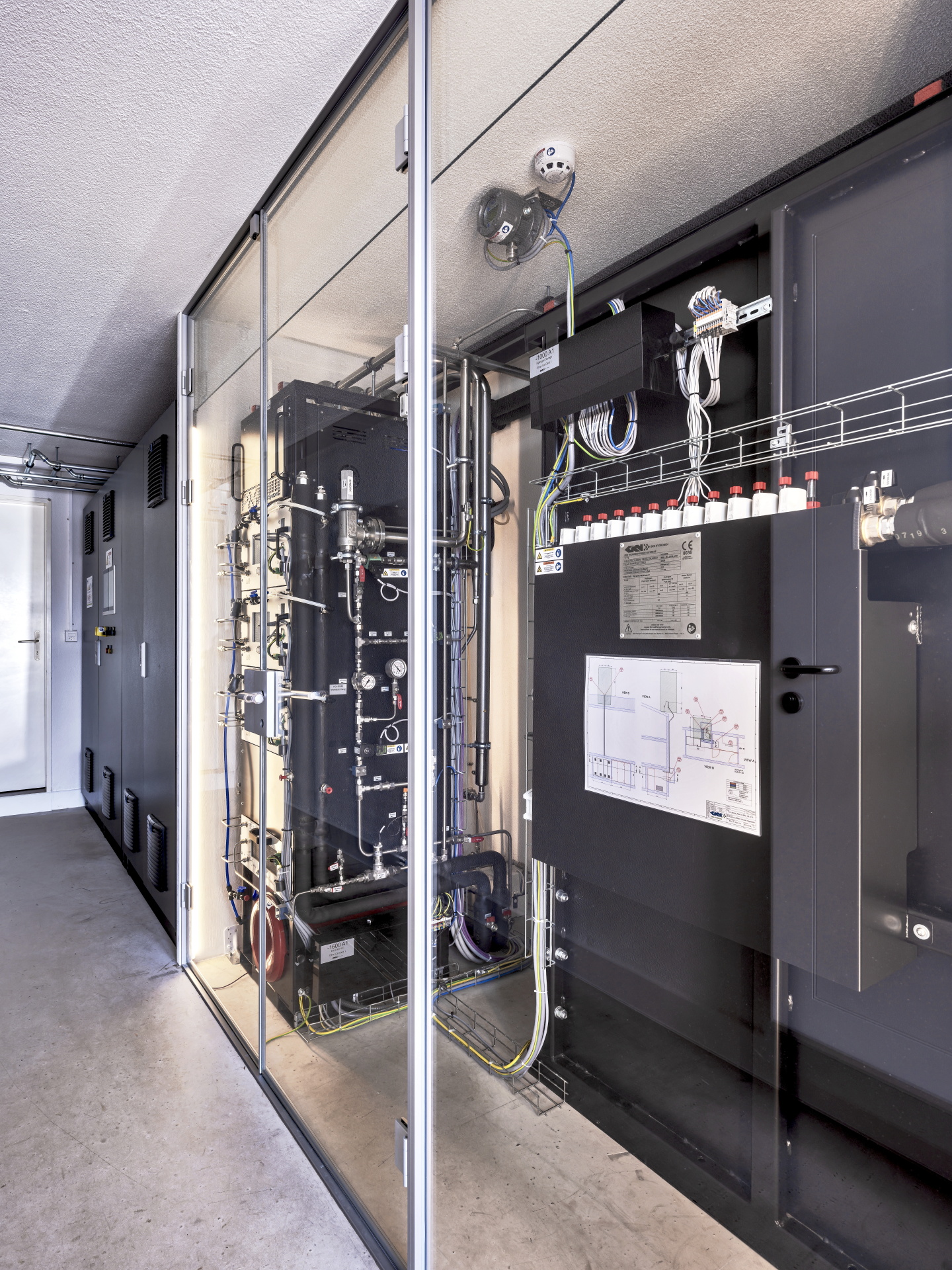
Large-scale battery storage can face two challenges in urban settings. Outdoors, it may encounter noise objections. Indoors, it may face fire-load and permitting constraints. Triewald is designed for installation in a plant room, operating quietly and without the same fire-load considerations as a large battery installation.
H₂ storage technology allowed inside buildings under SVGW Guideline H10001.
SVGW Guideline H10001 is the safety framework for building-integrated hydrogen systems and was co-developed by eRevo. It addresses risk analysis, fire protection, ventilation and explosion protection, and provides a basis for permits and SIA-compliant planning.
The largest amount of energy in the smallest space.
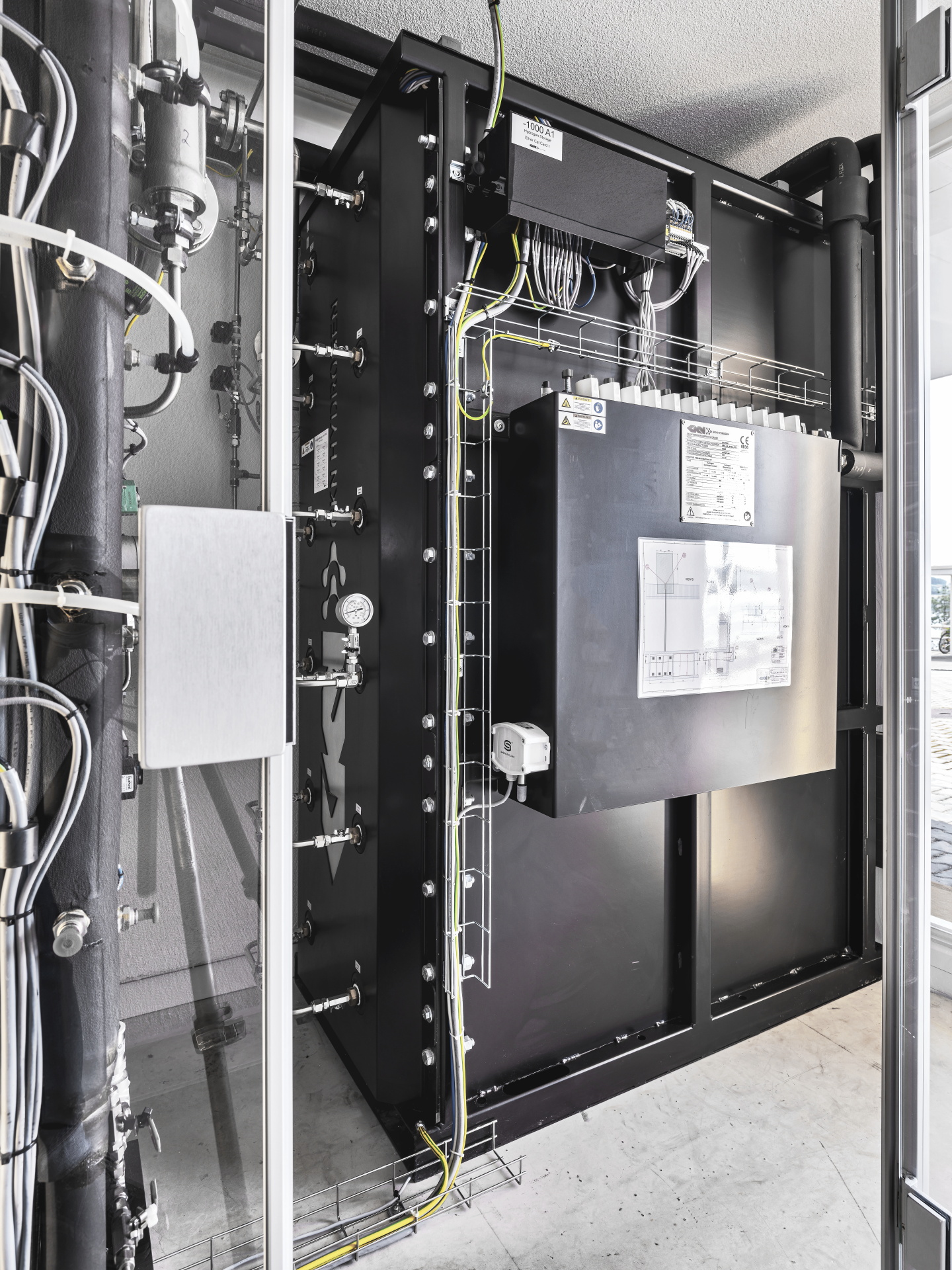
One kilogram of hydrogen occupies around 20 litres in metal hydride storage. In a 40-bar gas store, it occupies 310 litres. Compared with a 300-bar pressure vessel, it can remain around three times more compact, without requiring compression for storage, depending on the comparison basis.
One hundred per cent usable. Not eighty.
Subject to the system conditions, the stored energy can be made available in full. Batteries are generally not fully discharged during operation to protect their cells, leaving some nominal capacity unused.
A footprint that wins every comparison.
Each system occupies 84 square metres.. Four systems provide more than 100 MWh of storage capacity for an entire site, within an area comparable to one corner of an underground car park.
Zero self-discharge. Even after months.
The hydrogen is chemically bound in the metal lattice, with around 97% held in solid form. Summer surplus power remains safely stored until it is needed in winter.
Power and heat from a single system.
Over 75 per cent overall efficiency in coupled operation. The fuel cell supplies waste heat at up to 70 degrees, and the electrolysis supports the hot water preparation from summer onwards.
The most compact heat storage as well.
Because the energy is stored in the hydrogen molecule, the same amount of heat would require many times the volume in conventional water tanks.
On request, lights on when the grid goes down elsewhere.
On request we design the system to be black-start capable, so it keeps supplying the building it stands in during a grid outage. Because the long-duration storage holds the energy, autonomy lasts for days instead of hours. The plant in Eich is built that way.
No lithium. No rare earths.
All materials are available in Europe, with 80% of the production chain located in Switzerland. On decommissioning, the pure metal returns fully to the material cycle.
Over 30 years of service life.
The metal hydride storage technology comes with a performance guarantee of up to 20 years. If output declines after decades, the storage medium can be regenerated with a noble gas rather than replaced.
Four revenue streams instead of one.
Short-duration storage serves for fast electricity markets. Long-duration storage for seasonal shifting. Heat for the district network. Flexibility for the balancing market. All orchestrated by Energy Intelligence.
No single point of failure.
Main components are interchangeable across manufacturers. The system is built from series-produced industrial components from leading manufacturers, not prototypes.
From 0.5 to over 100 MWh.
Scalable from 0.5 to 16 MWh in a single room and to over 100 MWh across a site. Same technology, same permit logic, same control system.
In real-world operation since April 2024.
Not a pilot promise. The plant in Eich LU operates at full load, delivers operating data, design values and a referenced safety concept, and is available for site visits on request.