
For architects
The argument that decides competitions.
Energy you do not see. Architecture you remember.
Dezentrale Multi-Energie-Systeme // DMES
Energy concepts can decide competitions.
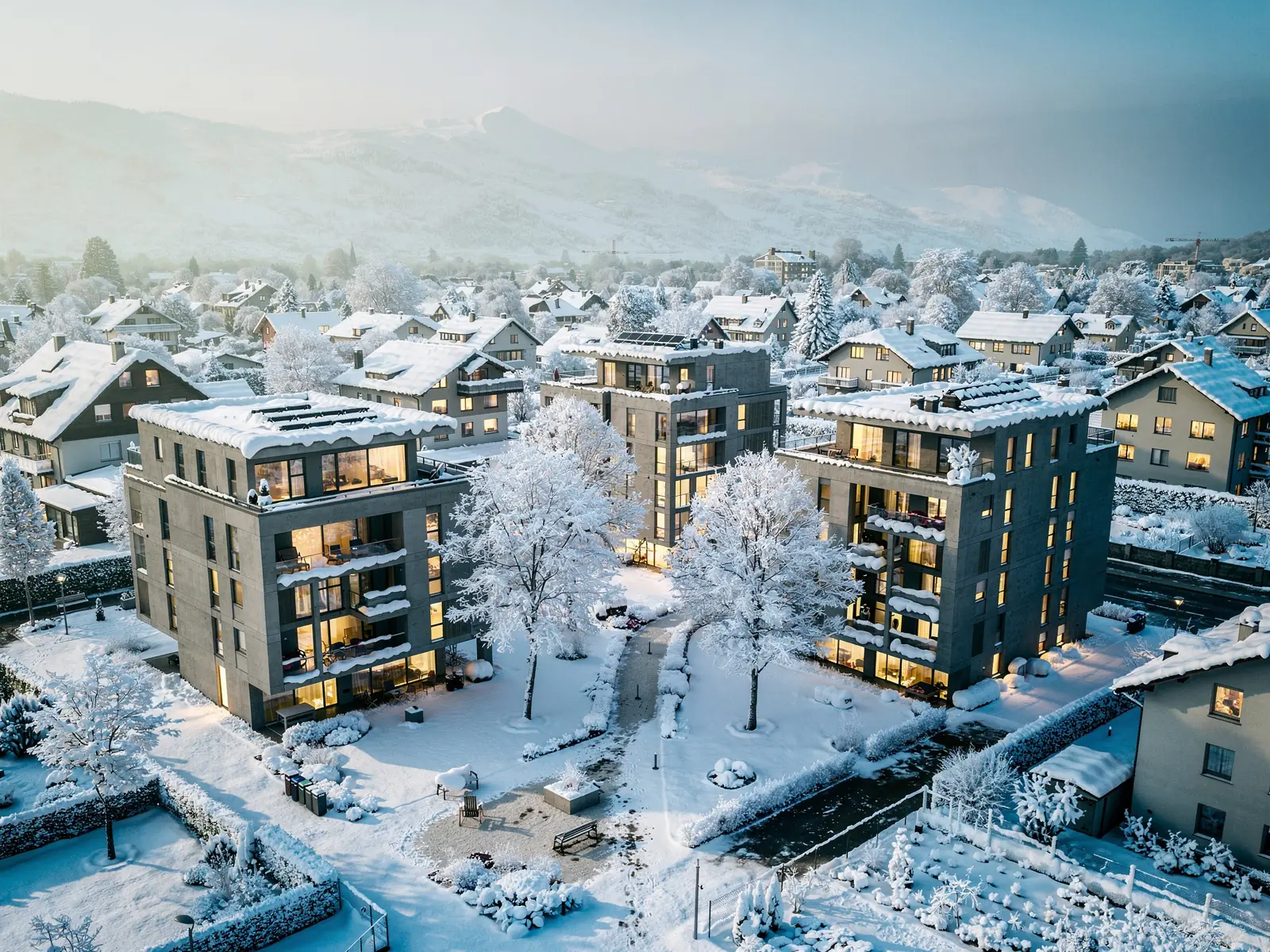
Sustainability has long been an important assessment criterion, both in competitions and direct commissions. SNBS, Minergie-Areal and the CO2 emissions reduction pathway demand answers that go beyond the building envelope. The reference work “Areale und Quartiere”, edited by Gugerli in 2024, described battery storage for day-to-night balancing and hydrogen for long-duration seasonal storage. The winter electricity gap calls for precisely this type of solution. At the same time, conventional solutions can interfere with the design. Battery containers require outdoor space and may cause noise objections. A more capable energy concept can therefore help distinguish a project.
Architecture that stores its own energy.
A DMES is the only large-scale storage system that is allowed inside an occupied building. It is quiet and compact like a plant room, without an outdoor container in the site concept or a noise barrier. The building stores summer electricity as hydrogen in metal hydride and returns it in winter as electricity and heat. PV gives the roof areas an additional purpose, while the energy infrastructure remains largely out of sight. The DMES can also function as a compact thermal store because the energy is stored in the hydrogen system rather than in a large water tank. The design gains an argument that can support the business case. A DMES can turn the building into a revenue-generating system for the client. We remove complexity and add potential returns.
Summer // surplus
-
 Photovoltaics
Own production on the roof
Photovoltaics
Own production on the roof
-
 Electrolysis
Electricity becomes hydrogen and heat
Electrolysis
Electricity becomes hydrogen and heat
-
 H₂ in metal hydride
Solid state at 35 bar, inside the building
H₂ in metal hydride
Solid state at 35 bar, inside the building
Winter // demand
-
 Fuel cell
Hydrogen becomes electricity and heat
Fuel cell
Hydrogen becomes electricity and heat
-
 Electricity
Site, vZEV and LEG, grid
Electricity
Site, vZEV and LEG, grid
-
 Heat
Heating, hot water, heat network
Heat
Heating, hot water, heat network
over 75% overall efficiency with combined electricity and heat use · over 30 years’ service life · 0.5 to 16 MWh per room · modularly scalable to over 100 MWh
The figures behind it.
Inside the building
No container in the outdoor space. Integrated like a plant room. 0.5 to 16 MWh per room, subject to applicable approvals and site conditions.
SVGW H10001
Your planning basis. The guidance note for building-integrated H₂ systems is the reference for SIA-compliant planning and was co-developed by eRevo.
More than 30 years
Service life. Infrastructure conceived as part of the building’s life cycle.
1,000 tonnes CO2
Emissions reduction pathway met measurably, year after year. From around 1,000 tonnes of CO2 per year, state funding instruments may become available.
Under ten years
Payback possible, under ideal conditions.
More than 75%
Overall efficiency with coupled use of electricity and heat.
Your clients trust your foresight. Give them one more reason.
Long-duration storage is becoming standard. Buildings designed today will stand for 50 years or more, and long-duration storage will likely become the norm within that timeframe. The recommendation is most persuasive when it comes from you. It expands the project scope through the energy centre and may help your client avoid a more expensive retrofit later.
You keep the lead.
No extra effort and no new discipline.
System architecture, dimensioning and integration planning come from eRevo, as does coordination of the specialist planners. You do not need to become an energy expert. You open the door and remain in the lead.
Seamless within the SIA phase model.
We work within your phases, from the preliminary study to realisation, with clear interfaces to HVAC, electrical, fire protection and conformity. Where the client wants design-build approach, we can provide that too. You choose the model and we fit in.
Proven in real-world operation.
The plant in Eich LU has been operating at full load since April 2024. Studies and mandates with Halter, Integral Design Build and the Canton of Lucerne. Realised by eRevo AG Energy Revolution, the pioneer of decentralised multi-energy systems in Europe.
The next step
Potential analysis
One month, one location, and one robust answer for your client. We provide the basis while you lead the conversation. The potential analysis fits into any SIA phase, although it is usually most effective during the preliminary study.