
For municipalities, corporations and district heating operators
The heat plant that can also earn from electricity.
Summer electricity surplus becomes heat for your network. Directly in summer and again in winter.
Dezentrale Multi-Energie-Systeme // DMES
The summer challenge for district heating.
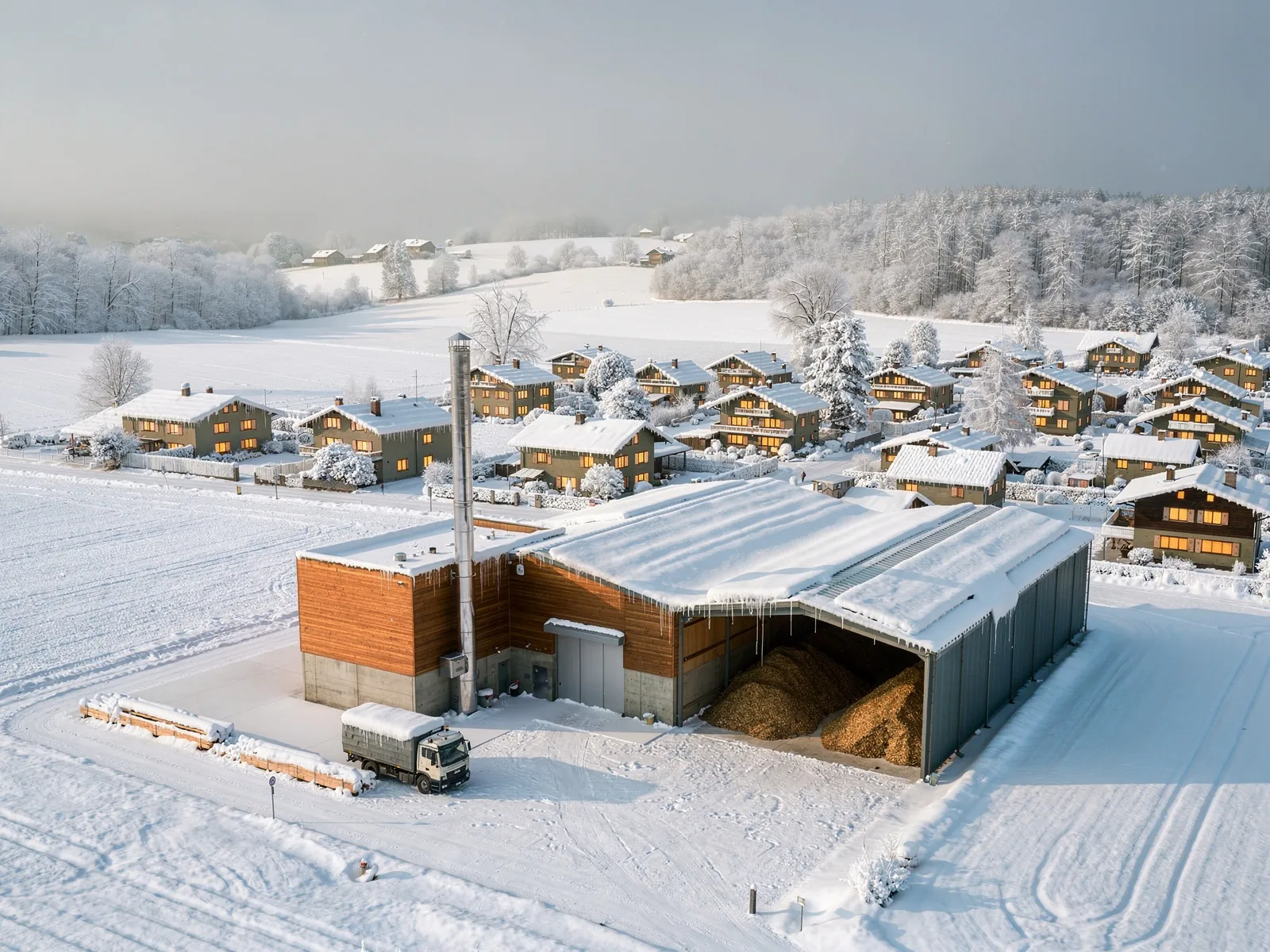
In summer the network still needs heat for domestic hot water. The load is small, however, so wood-fired boilers and fossil-fuel operate inefficiently at part load. Fuel costs and emissions continue for a relatively small amount of hot water. At the same time, the region produces a PV surplus that is curtailed or sold at low prices. These two challenges can potentially be addressed by the other. The reference work “Areale und Quartiere”, edited by Gugerli in 2024, emphasises the role of seasonal storage in thermal networks and identifies hydrogen as an option for seasonal energy storage.
Summer electricity becomes summer heat.
The DMES absorbs the surplus electricity. During charging, the waste heat of the electrolysis supports hot water production and summer network operation, entirely without fuel costs. The hydrogen remains stored in metal hydride, building-integrated and quiet. As soon as the system discharges, both come back. Electricity flows into the grid and into the region, and the waste heat of the reconversion to electricity feeds the heat network at up to 70 degrees, with every cycle run and then continuously in winter. This makes the DMES a thermal store as well, the most compact of its kind. The heat is stored in the hydrogen molecule instead of in the large volumes of water that fill entire storeys of conventional stores. And DMES are not an invention of ours. In its summary, the National Research Programme “Energy” of the Swiss National Science Foundation states verbatim “Implement decentralised multi-energy systems (DMES)!”. According to the summary, it is the municipalities and their utilities that are called upon to identify potential and to enable implementation through energy master plans and active support. Since 1 January 2026, the legal framework has also been in place with the local electricity communities (LEG). Heat pumps in a network also benefit. With the heat from the DMES, the output they have to deliver and their dimensioning both fall. And in winter the DMES relieves the peak load. What the store delivers, the wood-fired boiler does not have to provide. That means fewer full-load hours, fewer emissions and more reserve on the coldest days.
Summer // surplus
-
 Photovoltaics
Own production on the roof
Photovoltaics
Own production on the roof
-
 Electrolysis
Electricity becomes hydrogen and heat
Electrolysis
Electricity becomes hydrogen and heat
-
 H₂ in metal hydride
Solid state at 35 bar, inside the building
H₂ in metal hydride
Solid state at 35 bar, inside the building
Winter // demand
-
 Fuel cell
Hydrogen becomes electricity and heat
Fuel cell
Hydrogen becomes electricity and heat
-
 Electricity
Site, vZEV and LEG, grid
Electricity
Site, vZEV and LEG, grid
-
 Heat
Heating, hot water, heat network
Heat
Heating, hot water, heat network
over 75% overall efficiency with combined electricity and heat use · over 30 years’ service life · 0.5 to 16 MWh per room · modularly scalable to over 100 MWh
The figures behind it.
Summer and winter
Heat in both seasons. In summer, from waste heat produced by electrolysis. In winter, from reconversion to electricity at up to 70 degrees.
More than 30 years
Metal hydride service life. Infrastructure designed for a municipal horizon and a generational project. The manufacturer guarantees storage performance for more than 20 years.
1,000 tonnes CO2
Decarbonisation that pays off. Your heat network progresses measurable along its emissions reduction pathway. From around 1,000 tonnes of CO2 per year, state funding instruments may become available.
29 MWh · 1.2 MWth
Reference design AREAL. 29 MWh of thermal storage with 1.2 MW of thermal output per storage cycle. In addition, 101 MWh of storage and 12 MW of electrical output.
Under ten years
Payback possible, under ideal conditions.
More than 75%
Overall efficiency with coupled use of electricity and heat.
Net zero is a heat project.
Anyone who decarbonises a heat network progresses measurably along the municipality’s emissions reduction pathway year after year. The long-duration store works without rare earth elements or lithium, and 80% of the production chain is in Switzerland. At decommissioning, the pure metal can return fully to the material cycle. This supports circular construction in heat infrastructure too.
One partner for the whole system.
One system, one point of contact.
System architecture, dimensioning, integration planning and business models come from eRevo. The partner ecosystem supplies components, contracting, HVAC, electrical, fire protection and conformity through one coordinated structure.
Energy Intelligence as a dedicated layer.
Forecast-based control and multi-asset optimisation across electricity, heat, H₂ and grid supply. Every plant learns, and each new one starts with the benefit of that experience.
Proven in real-world operation.
The world premiere installation in Eich LU has been operating at full load since April 2024. Long-term service agreements and performance commitments support the project term. The system was realised by eRevo AG Energy Revolution, the pioneer of decentralised multi energy systems in Europe.
The next step
Blueprint
We design your network using the heat-load profile, PV potential, grid costs and the complete business case. You see when the plant may pay for itself and what it could earns over the following decades.