
For utilities, industry & contracting
From cost factor to revenue system.
Electricity, heat and flexibility from one energy centre.
Dezentrale Multi-Energie-Systeme // DMES
Grid expansion is expensive. Storage can be faster to deploy.
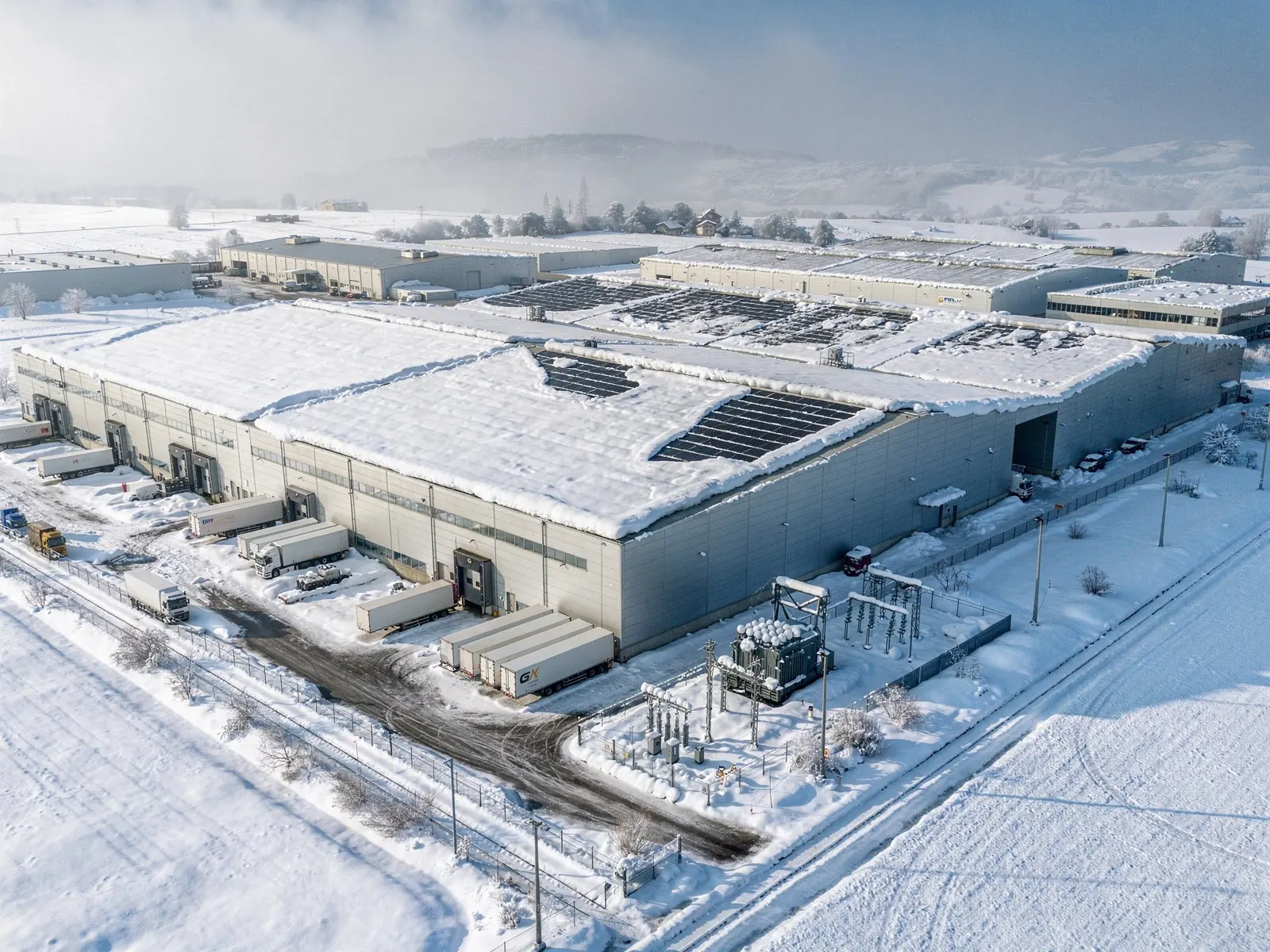
The Swiss PV expansion from around 10 to up to 40 GWp makes neither technical nor economic sense without storage, according to the Swissgrid white paper of March 2026. Annualised grid costs are expected to rise by up to 100 per cent by 2050. The bottleneck is not generation itself, but the timing of grid capacity and demand. The conventional response can be slow. Swiss utilities report that roughly half of their BESS projects encounter noise-related objections ultimately resulting in failure. Inside buildings, large battery stores can face fire-load and approval constraints. Anyone seeking urban flexibility needs a different approach.
One system, three revenue streams.
Each storage system operates in its own market. A DMES is not merely an electricity store, but an energy centre with three revenue streams. The integrated short-duration store serves the fast markets, including control energy, intraday, peak shaving and system services. The metal hydride long-duration store supports the seasonal shift and grid relief, building-integrated and with a service life of over 30 years. Thermal extraction supplies heat in both seasons, and because the energy is stored in the molecule, the DMES is at the same time the most compact thermal store. And DMES are not an invention of ours. In its summary, the National Research Programme “Energy” of the Swiss National Science Foundation states verbatim “Implement decentralised multi-energy systems (DMES)!”. Among its reasons it names the fact that DMES avoid costly grid expansion. Energy Intelligence orchestrates all levels. Revenue stacking instead of dependence on a single market. Added to that is security of supply. On request we design the system to be black-start capable, so it carries the building it stands in through a grid outage. Thanks to long-duration storage, autonomy then lasts for days instead of hours. And where there is no grid, a DMES can also be designed as a permanent island grid.
Summer // surplus
-
 Photovoltaics
Own production on the roof
Photovoltaics
Own production on the roof
-
 Electrolysis
Electricity becomes hydrogen and heat
Electrolysis
Electricity becomes hydrogen and heat
-
 H₂ in metal hydride
Solid state at 35 bar, inside the building
H₂ in metal hydride
Solid state at 35 bar, inside the building
Winter // demand
-
 Fuel cell
Hydrogen becomes electricity and heat
Fuel cell
Hydrogen becomes electricity and heat
-
 Electricity
Site, vZEV and LEG, grid
Electricity
Site, vZEV and LEG, grid
-
 Heat
Heating, hot water, heat network
Heat
Heating, hot water, heat network
over 75% overall efficiency with combined electricity and heat use · over 30 years’ service life · 0.5 to 16 MWh per room · modularly scalable to over 100 MWh
The figures behind it.
101 MWh · 12 MW
Reference design AREAL. Four identical systems with a total footprint of 336 m². In addition, 29 MWh of thermal storage and 1.2 MW of thermal output.
More than 30 years
Metal hydride service life. A BESS typically has a shorter service life, while the metal hydride storage system is designed to last for more than 30 years.
20,000 cycles
Cycle stability. More than 98% of the stated performance remains afterwards, subject to the test conditions and definition of performance.
Up to twenty years
Performance guarantee for the metal hydride storage technology. This is one basis of bankability.
Under ten years
Payback possible, under ideal conditions.
More than 75%
Overall efficiency with coupled use of electricity and heat.
Heat in both seasons. No BESS can do that.
The system can deliver heat while charging and discharging. During charging, waste heat from the electrolysis supports hot-water production. During discharge, the fuel cell provides heat, and in winter its waste heat can also feed the network. Without wood or fossil fuels, a storage project can create an additional revenue stream in the heat business.
Decentralised, intelligent, and designed for financeability.
Decentralised instead of centralised.
The energy centre is built where generation and consumption take place. This can reduce transmission losses and does not require a national H₂ infrastructure as a precondition.
Energy Intelligence as a dedicated layer.
Forecast-based control and multi-asset optimisation across electricity, heat, H₂ and grid supply, with peak shaving and balancing in vZEV and LEG structures. The capability is anchored in the founding team.
Structured for financeability.
Long-term service agreements and performance commitments cover the project term. Main components are interchangeable across manufacturers, reducing dependence on a single supplier. The system was realised by eRevo AG Energy Revolution, the pioneer of decentralised multi energy systems in Europe, and has been proven in real-world operation since April 2024.
The next step
Blueprint
We design your location using load profiles, PV yield, waste heat, grid costs and the complete business case. You see when the plant may pay for itself and what it could earn over the following decades. Dimensioning follows your load profile, not a rule of thumb.